
How PET Preforms Are Made and Blown into Bottles
How a PET bottle is made in two steps: first an injection machine molds a small test-tube-shaped preform, then a stretch blow machine reheats it and blows it into the bottle — the whole route in plain language, with footage of real machines.
What is a PET preform? A PET preform is a small, test-tube-shaped piece of injection-molded PET with the bottle's neck already finished. It is later reheated, stretched and blown into a clear bottle. In the two-step route, one machine molds the preforms and a second machine blows them.
Key takeaways
- The two-step route uses a preform injection molding machine first, then a stretch blow machine that reheats the preform and blows the bottle.
- The preform's neck is finished in the preform mould; blowing does not change it.
- Stretching in two directions at once gives PET its clarity and strength.
- Common commercial preform moulds run 16, 24, 32, 48 or 72 cavities.
- A PET bottle programme needs two tools, a preform mould and a stretch blow mould; the preform mould takes 40–60 days.
 Watch: the process running
What you will see: the mould opening, a robot taking a row of clear preforms out and setting them on a conveyor.
This page explains the two-step route that most clear PET water and drink bottles take. If you want to make the preform and the bottle on one machine, see one-step injection stretch blow molding. AMAN supplies PET preform injection molding machines and cuts the PET preform moulds and stretch blow moulds in its own workshop. We have done this since 2007.

Figure 1. The preform neck stays the same; the body is stretched and blown.
Part 1 — making the preform
A preform is the small, test-tube-shaped piece of PET that a bottle is later stretched and blown from. Its neck is already finished: the thread of the bottle is molded here, and the blowing step does not change it.
1. Melt the PET. PET is dried first, then melted by a rotating screw. PET granules are dried first — PET takes up moisture from the air, and water left in the resin breaks the polymer chains when it melts — and then melted in a heated barrel by a rotating screw.
2. Inject into the preform mould. The melt fills a multi-cavity mould. The screw pushes the melt into a multi-cavity preform mould. Common commercial preform moulds run 16, 24, 32, 48 or 72 cavities; the right number is worked out from the output you need and what your machine's clamping unit can hold.
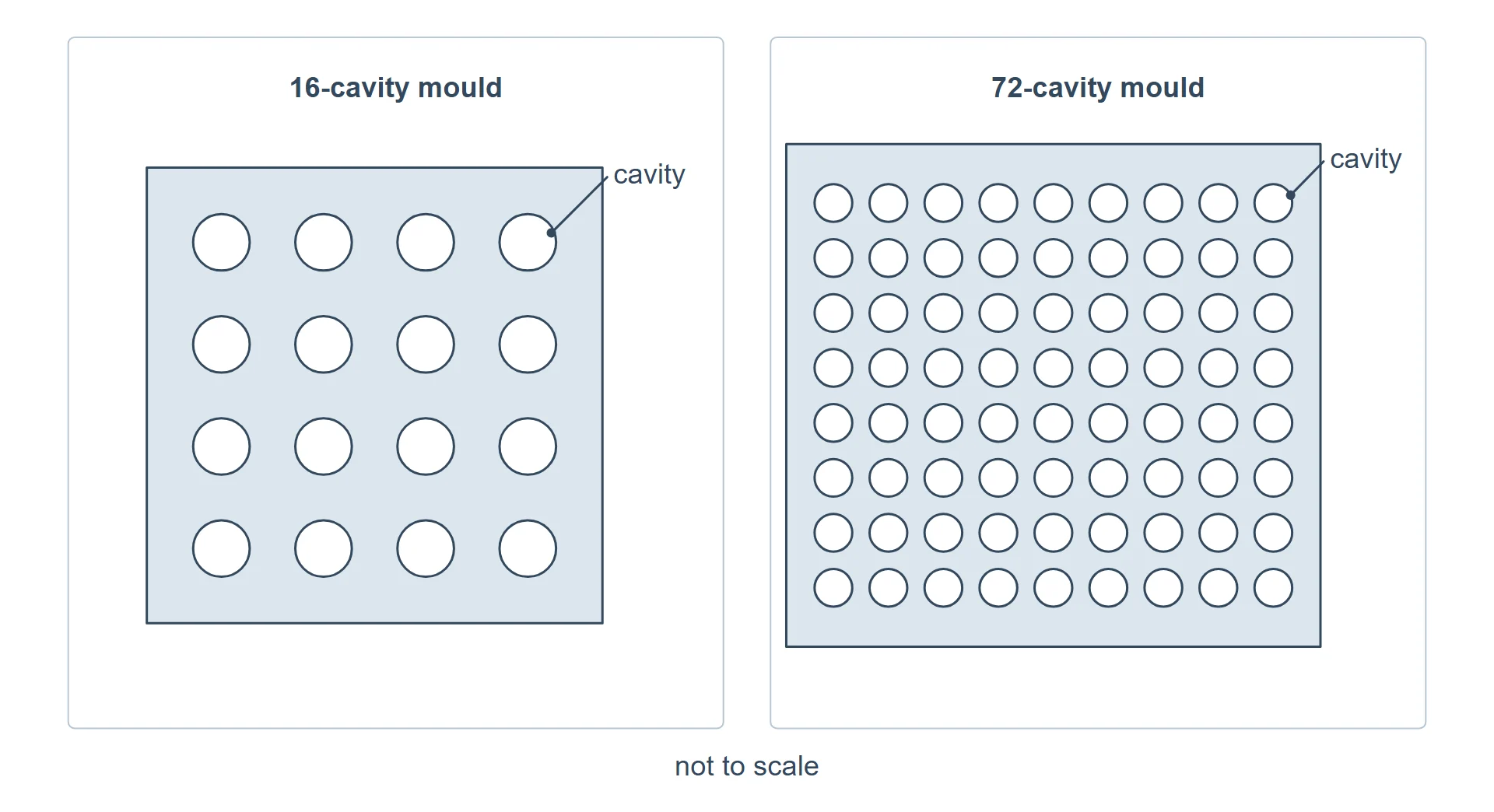
Figure 2. Step 2: more cavities, more preforms per cycle (schematic, not to scale).
3. Cool. Cooling is normally the longest part of the cycle. Water channels in the mould carry the heat out while the preforms solidify.
4. Open and take out. A robot takes the preforms out onto a conveyor. The mould opens and a robot takes the preforms out, setting them on a conveyor. In our footage the clear preforms come off the mould row by row.
Part 2 — blowing the bottle
5. Reheat. The preforms are heated to their blowing temperature. The preforms go through a heating oven until they reach their blowing (orientation) temperature — the range in which PET stretches evenly and its molecules line up, instead of cracking or turning hazy. In the footage below, the preforms glow red under the oven lamps.
 Watch the footage
Footage: the preforms glow red under the oven lamps of a stretch blow machine.
6. Stretch and blow. A stretch rod and compressed air stretch the preform in two directions. A robot places the heated preform in the blow mould. A stretch rod extends the preform lengthwise while compressed air expands it outward. Stretching in two directions at once is what gives PET its clarity and strength — which is why a bottle can be made light without becoming weak.
7. Cool and eject. The bottle holds its shape against the cooled mould wall. The mould opens and the bottle is taken out — onto a conveyor, or by air conveyor to the filler.
Two routes: two-step or one-step

Figure 3. Two routes to a PET bottle.
| Two-step | One-step (injection stretch blow) | |
|---|---|---|
| Machines | Preform injection molding machine, then a separate stretch blow machine | One machine does both: one-step injection stretch blow molding machines |
| Preforms | Made, stored and reheated | None to buy, store or reheat |
| Usual use | 0.5–2 L water and beverage bottles | Bottles from 100 ml up to 5-gallon (19 L) water bottles in PC (polycarbonate, another clear plastic), depending on the model |
| Tools | Preform mould + stretch blow mould | Preform and blow moulds on one machine |
Choosing a preform machine
| Economical series | Efficient series | |
|---|---|---|
| Machines listed | 22 | 9 |
| Who it is for | Small and medium output, or producers starting a new line | High-cavity production at volume |
Tell us your preform weight, neck finish and hourly output, and we recommend the series, the cavity layout and the mould.
The mould: two tools, five facts
A PET bottle programme needs two tools: the preform mould and the stretch blow mould. A preform mould is quoted from five facts: your neck finish (the thread standard of the bottle neck; if you do not know what it is called, send us a cap or a dimensioned drawing); the preform weight, or if you do not know it the finished bottle (volume, still or carbonated, hot-fill or ambient); your output target; the machine it will run on; and the resin and colour. We cut preform moulds in our own workshop for our machines and for yours, and the lead time is 40–60 days from approved drawings.
What you receive with the mould
The preform mould is where a PET bottle programme starts. AMAN cuts the multi-cavity, hot-runner preform mould in its own workshop, to your neck finish and preform weight and to fit your existing preform machine, whether or not the machine came from us. Trial parts moulded on our own machine are packed in the same crate as the tool. Send the five facts above and we quote the mould with the workable cavity options.
FAQ
What is a PET preform?
A PET preform is a small, test-tube-shaped piece of injection-molded PET with its neck already finished. It is later reheated in an oven and stretch-blown into a bottle. Because the neck is finished in the preform mould, the blowing step does not change the thread of the bottle.
PET bottle manufacturing process
A PET bottle is made in two steps. First a preform injection molding machine melts dried PET and injects it into a multi-cavity mould, and a robot takes the preforms out. Then a stretch blow machine reheats each preform, stretches it with a rod, blows it with compressed air against a cooled mould and ejects the bottle.
How is a preform turned into a bottle?
A preform is turned into a bottle by reheating it in an oven until it reaches its blowing temperature, placing it in a blow mould, stretching it lengthwise with a rod while compressed air blows it outward, then cooling the bottle against the mould wall and ejecting it. A robot places the heated preform in the mould.
Why is PET stretched in two directions?
PET reaches its full strength, and stays clear, when it is stretched in both directions during blowing, so the polymer chains line up. Unstretched PET is weak, and PET stretched at the wrong temperature can turn hazy. Good stretching is also what lets a bottle be made lighter without losing strength.
Two-step vs one-step stretch blow molding
In a two-step route, a preform machine molds the preforms and a separate machine reheats and blows them; it is the usual route for 0.5–2 L water and beverage bottles. A one-step machine does both in one machine, so there are no preforms to buy, store or reheat, for bottles from 100 ml up to 5-gallon water bottles in PC.
PET preform mould cavities
Common commercial preform moulds run 16, 24, 32, 48 or 72 cavities. The right number depends on your output and what your machine's clamping unit can hold, so we work it out from your output target and put the workable options on the quotation, with the trade-off explained in plain words.
What do you need to quote a preform mould?
A preform mould is quoted from five facts: the neck finish (or a sample cap), the preform weight (or the finished bottle), your output target, the machine it will run on, and the resin and colour. Send them and you get an exact quote within 24–48 hours.
Do you make preform moulds for machines that are not yours?
Yes, we cut PET preform moulds to fit your existing preform machine, whether or not the machine came from us. The mould is cut in our own workshop and takes 40–60 days from approved drawings. Tell us the make and model of your machine and your neck finish and we quote it.
Related: PET preform moulds · PET stretch blow moulds · PET preform mould design · PET injection stretch blow molding machines
Planning a PET bottle line?
Send your bottle or preform drawing and get an exact quote within 24–48 hours.
Browse PET preform injection molding machines →Get a machine quote for your part
No drawing yet? Photos of a sample part work too. This is all we need to match the machine and quote it:
- ✓Part drawing, 3D file, or photos from all sides
- ✓Part size and weight
- ✓Material, e.g. PP, HDPE or PET
- ✓Pieces per hour, or the tonnage you have in mind